The four months as a sequence of decisions
- Rule out demand. Known: full schedules and a growing patient base, with collected revenue trailing. The question was whether this was a volume problem, an effort problem, or something upstream of both. Full schedules answered the first in one look, which moved the search off marketing and onto the claims themselves.
- Trace one claim. Known: claims were coming back denied or short. The question was what the payer had actually said on a single claim, and where in the chain that reason had been built in. Walking one claim backward with the billing lead put the defect at submission, in the code, not in the follow-up. It changed the subject from how hard people worked to what the system produced.
- Find out why the codes were stale. Known: the code was wrong at submission. The question was when this system had last updated its codes and who was responsible for that happening. The answer was the software tier and the setup. Nobody had bought the updates, nobody had configured the system to take them, and nobody owned the question. That relocated the defect from the billing desk to a maintenance task with no owner.
- Choose the fix at the level of the defect. Known: a maintenance gap, not an effort gap. The question was the smallest standing habit that would keep this from recurring. The answer was the right software tier, a proper setup, the codes corrected, and a weekly check with a named owner inside the office. Not a new platform, not a new hire, not a vendor.
- Rebuild the paperwork. Known: the office could not reliably find its own records, and a payer's request for documentation is a deadline. The question was what the front desk needed to be able to find in a minute, and where each of those things would live. The rebuild ran with the office manager and the front desk, because a filing system the people who use it did not build does not survive its first busy week.
- Separate staff from practitioners. Known: business and personal had grown together across the sites, and that was an operating risk, not a personality problem. The question was what line would let the practices be run as a business without asking anyone to stop being who they were. The answer was a set of firewalls between the employees and the practitioners on the business side, treated as structure and written down, not managed around.
- Hand the check to its owner. Known: correcting the codes fixed that month's claims, not the next update cycle. The question was what would make the fix survive without me in the building. The weekly check ran from its first week as the office manager's task, not mine, so that by the time I left the practice had already been doing it for weeks on its own.
The intake question set, as I ran it
These are the questions I asked in the first weeks, each in place of the more obvious one, and what the answer locates.
- Is this shortfall a volume problem, an effort problem, or something upstream of both? Asked instead of how many new patients we can add. A full schedule with lagging revenue rules out demand in one answer.
- When was the billing software's code set last verified against current payer and coding standards? Asked instead of why billing is slow. It tells you whether the codes claims are built on are current at all, independent of how hard anyone works them.
- Were the software's updates and plugins being paid for and applied on the vendor's schedule, or skipped? Asked instead of whether we need more billing staff. A skipped update is a maintenance gap, not a staffing shortfall.
- Of the claims coming back denied or short, how many cite an invalid, outdated or non-covered code, against a different reason? Asked instead of how fast billing can appeal. It measures how much of the shortfall the code problem explains, rather than assuming it.
- Is there a standing habit that checks code currency, or does it only get checked when someone notices? Asked instead of whether we are losing money on denials. It tells you whether the gap is structural, with no owner and no schedule, or a lapse that already got caught.
- Beyond billing, what else in daily operations runs on old habits nobody has revisited? Asked instead of whether the practice is well run. This is what surfaced the paperwork and the line between staff and practitioners.
- What makes this fix survive once the fractional seat ends? Asked instead of whether the numbers improved this month. It tells you whether the check is a habit with a named owner or a task that only happens while I am in the building.
The set deliberately does not ask how to collect harder or appeal faster, because both assume the claims were right when they went out, which is the one thing the set exists to test first.
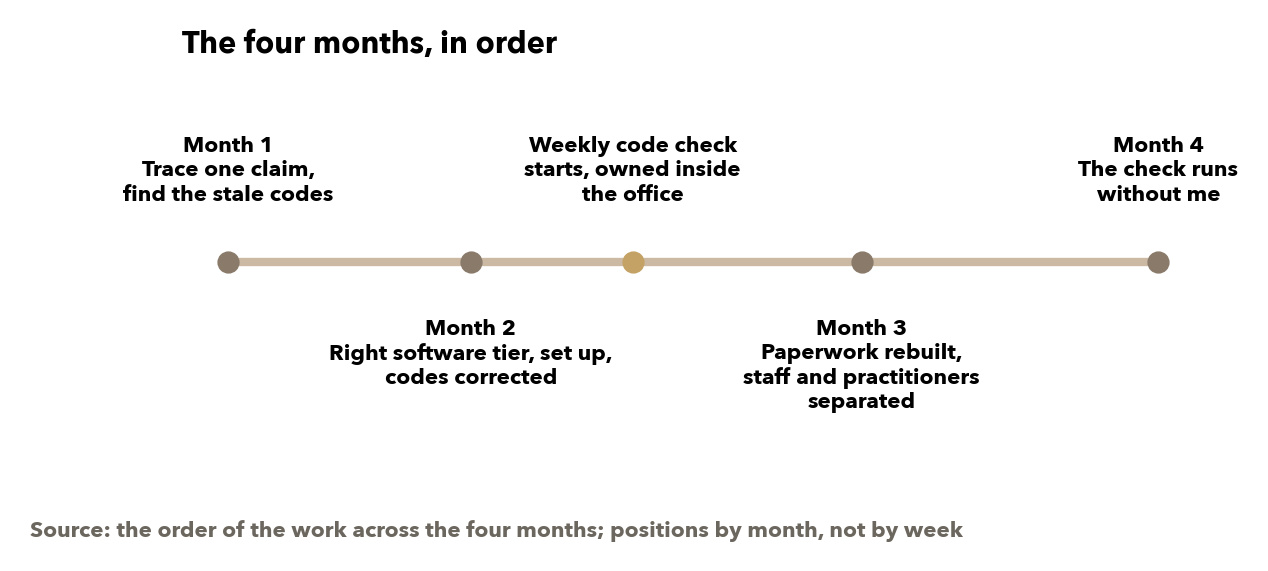
The ladder below is the whole diagnosis in one column. Each rung is what the problem looked like from that height, and the question that took me down one more.
| Rung | What it looked like from there | The question that took me down a rung |
|---|---|---|
| Cash short each month | A collections problem | What would have to be true for that to be right |
| Denials and short payments up | Billing staff not chasing hard enough | What did the payer actually say on one claim |
| Claims wrong at submission | A coding error, someone's mistake | Where in the chain was that code built in |
| Codes out of date | An IT detail | When did this system last update its codes |
| Wrong tier, no updates | A cost saving | Who was responsible for that happening |
| Nobody owned it | Nothing, because nobody was looking | What is the smallest habit that keeps this from recurring |
What it produced
The one figure a reader could check sits on the cover, once, and the curve on the private side is modeled from that single input. Insurance billing is drawn as an index there, with claims submitted held flat because the schedules were already full before I arrived. The rise starts in the second month, when the codes were corrected and the check began, and it runs in a straight line because I have the month-four figure and not the months between. What the shape says is the point. The volume of work did not change. The same patients, the same procedures and the same billing lead produced more paid claims, because the claims stopped dying at the clearinghouse before a human ever saw them.
The second thing it produced was less visible and, I think, more durable. The check kept running after I left, and so did the paperwork system. A fix that survives the person who installed it is the only proof that the fix was real. If it had lapsed the month I left, the curve on the cover would have been my curve, not theirs.
The practice is still open and still seeing patients. Its public reviews sit on Yelp, for the Riverside office and the Mission Viejo office.
| What the owner saw | What was true | What changed |
|---|---|---|
| Denials and short payments; a collections problem | The codes were out of date, so the claims were wrong at submission | Codes corrected, then a weekly check with a named owner inside the office |
| A billing system that worked | The wrong software tier, updates and plugins never bought, the setup incomplete | The tier that carries the updates, set up properly |
| Billing staff not chasing hard enough | Real effort spent on claims that were invalid the moment they were sent | The same people, with the claims right at submission, so effort went to real denials |
| Paperwork as a nuisance | The office could not reliably find its own records when a payer asked | A rebuilt paperwork system, built with the people who use it, kept after I left |
| A close team across the sites | Business and personal had merged, and that was an operating risk | A written line between staff and practitioners on the business side |
| Software maintenance as an IT detail | A task with no owner does not happen | An owner and a schedule |
The fix is usually smaller and more boring than the story the client tells about the problem. This seat set that pattern for every one after it.
What we kept, what we replaced, what we installed
We kept the practice-management and billing software, the billing lead, the front desk and every practitioner. The decision was explicitly not to buy. We replaced the software tier and its setup, and the paperwork system. We installed the weekly billing-code check and the line between staff and practitioners.
The process that mattered was the maintenance of the code table, and it deserves its own account. The owner had put the original arrangement in place when the practice bought its software, by choosing the cheapest tier and treating updates as optional IT. The reason was cash and attention. A provider-led practice sees clinical work as the product and billing as overhead, and overhead is where a good provider saves money. The logic was faulty in one specific place. It treated the code table as static. A code table is a moving target set by payers and the coding authorities on their own calendars, some annual and some quarterly, so a system set up once and left alone is guaranteed to drift, and the drift shows up months later as a collections problem that nobody connects to a skipped update. It had to change now because every month of drift was compounding as denials and write-offs, and the practice was adding patients, so the leak grew with success.
The paperwork rebuild followed the same logic. Nobody had designed the filing; it had accumulated, one binder and one habit at a time, as the practices grew. The line between staff and practitioners was different in kind, because nobody had put it in place at all. Small owner-run groups grow their relationships faster than their roles, and at some point the business needs a boundary that the people in it were never going to draw for themselves.
The rule the check runs on
Every code in use is verified current against the payer and coding calendars, weekly, by a named person in the office, with the date and the result written down. If the owner of the check changes, the check does not pause; the new owner is named the same day.
What it cost to hold the line, and what I would watch
Holding the line cost a few things. It meant telling an owner that the problem was cheaper and less flattering than the story the building told, and that the fix was a software tier and a weekly habit rather than a plan he could be proud of. It meant telling a billing lead who had been working hard that harder was not the answer, and then keeping that person, because the effort had been real and the target had been wrong. The line between staff and practitioners cost goodwill in the weeks it went in, in rooms where people had been friends before they were colleagues. And it meant declining to be the person who ran the check myself, when doing it myself would have been faster and would have made me look more useful. A fractional operator who becomes the maintenance is a maintenance gap with a contract.
What I would watch, in a group like this one. Whether the check has an owner by name after the next staff change, because the check does not fail loudly; it stops, and the denials arrive a quarter later. Whether the software tier stays paid for at renewal, because the cost instinct that created the problem comes back at every renewal notice. Whether the paperwork system survives its first busy quarter, which is when people revert. And the denial reasons, monthly, read by someone who knows what the categories mean, because a code problem that has been fixed comes back next as a payer-rule problem, and the only early warning is a reason code that a busy office is inclined to ignore.
The result, in short
Insurance billing up 42 percent month over month by month four, on the same patients, the same procedures and the same billing lead. The claims stopped dying at the clearinghouse before a human ever saw them. The client kept the weekly code check and the rebuilt paperwork system after the seat ended, which is the only real proof the fix was real.
A slice of the project list
A few related projects.
- Greensleeves Steakhouse: co-owner and operator, a landmark restaurant turnaround (2016 to 2022)
- AXT Axe Haus: owner and operator of an axe throwing venue, entitlement fight and a long-term position (2018 to present)
- A PE-backed medical group: operating audit (2026)
- Contractor Gorilla: advisor with an equity position, a marketing agency built for contractors (2014 to 2017)